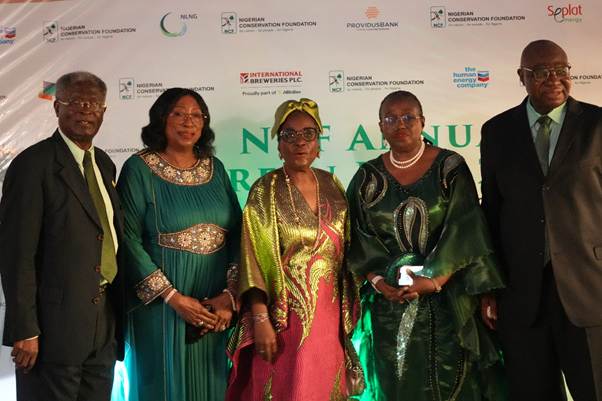
On Saturday, November 22, 2025, the La Scala Hall & Terrace of the MUSON Centre in Onikan, Lagos, transformed into more than a venue of elegance and music. It became a rallying ground for environmental action.
The Nigerian Conservation Foundation’s Annual Green Ball has long stood as a flagship conservation event. But this year’s edition themed, “Raising Finance to Beat Plastic Pollution” was distinct in urgency, clarity, and purpose. It was not simply a celebration. It was a strategic call to invest in Nigeria’s environmental future.
From the green carpet reception and mini exhibition to the stirring documentary presentation and resounding call for support, the evening fused advocacy with action, elegance with evidence, and vision with responsibility.
The Crisis Beneath the Surface
The highlight of the evening was the screening of “Beyond the Bottle: Battle Against Plastic Pollution,” a powerful documentary that laid bare the scale of Nigeria’s plastic crisis.
Opening with sweeping aerial views of Lagos vibrant, energetic, unstoppable the film quickly shifted to a quieter but more troubling reality: clogged drains, plastic-choked waterways, flooded streets, and coastal communities battling the consequences of waste mismanagement.
Nigeria generates an estimated 2.5 million tonnes of plastic waste annually, yet efficient disposal and recycling systems remain inadequate. What is used for minutes lingers for centuries. A single plastic bottle can take up to 450 years to decompose. Globally, only about 9% of plastic ever produced has been recycled.
In coastal communities, plastic waste flows into rivers and oceans. Fish ingest microplastics. And as Hon. Justice (Mrs.) R.I.B. Adebiyi, Chairman of the NCF National Executive Council, warned during media interviews, “Plastics get into the ocean, fishes feed on them, and we in turn feed on these fish.” The consequences are no longer distant environmental concerns; they are immediate public health realities.
Lagos, she emphasized, bears a particularly heavy burden. Blocked drainage systems and waterways contribute significantly to incessant flooding, disrupting livelihoods and endangering communities. The crisis is ecological, economic, and deeply human.
Leadership Voices: Why This Moment Matters
In her welcome address, Hon. Justice Adebiyi highlighted the alarming rate at which plastics are generated in Nigeria and the urgent need for more efficient disposal mechanisms. She stressed the importance of intensified public awareness, a culture of recycling, and stronger accountability from industries and manufacturers to prioritise recyclable materials.
Plastic pollution, she made clear, is not merely about waste but about systems, responsibility, and collective action.
Dame Marie Fatayi-Williams, Chairman of the Business Development Committee of the National Executive Council, underscored the event’s timeliness, particularly in light of the Lagos State Government’s ban on single-use plastics.
“It is important for us to create that awareness for people to see and comprehend the damage that non-degradable plastic does to the environment,” she noted.
The policy shift signals progress, but legislation alone is not enough. Implementation, infrastructure, and financing must follow.

From Waste to Wealth: Financing the Solution
While the documentary painted a stark picture, it did not end in despair. Instead, it pivoted toward possibility.
Across Nigeria, innovative recycling hubs are emerging. Young entrepreneurs are transforming plastic waste into paving tiles, fashion accessories, and building materials. Communities are organising clean-up drives. Schools are integrating environmental education into their curriculum.
Plastic pollution, as the film compellingly argued, is no longer just an environmental issue it is an economic opportunity waiting to be scaled.
But scale requires capital.
The theme of the evening Raising Finance to Beat Plastic Pollution reframed the conversation. This was not a plea for charity. It was an invitation to invest in infrastructure, in green entrepreneurship, in circular economy systems, and in a cleaner future.
Every recycling hub requires equipment. Every awareness campaign requires resources. Every innovation requires seed funding. As the documentary declared: “What we choose to fund today will define the world our children inherit.”
The Green Ball became the bridge between awareness and investment.

Conservation Beyond Lagos: A National Mandate
Plastic pollution is one piece of a larger environmental puzzle; one the Nigerian Conservation Foundation has been addressing for decades.
NCF Director-General, Dr. Joseph Onoja, commended partners for their sustained support of projects in coastal protection, community-based conservation, and environmental education. He reaffirmed that curbing plastic pollution is essential to building a cleaner and healthier environment for present and future generations.
Beyond Lagos, NCF’s work stretches from the Niger Delta to the Sahel. In the Hadejia-Nguru Wetlands, the Foundation works with local farmers to develop early warning systems that track rainfall patterns and climate variability protecting both biodiversity and livelihoods. In coastal regions, efforts focus on habitat preservation and resilience. In schools and communities, environmental education continues to shape a new generation of eco-conscious citizens.
The Green Ball, therefore, is not an isolated event. It is a funding engine for nationwide conservation impact.

A Call That Echoed Beyond the Ballroom
As the evening unfolded interspersed with music, spoken word performances, goodwill messages, and moments of reflection the underlying message remained clear.
The time to act is now.
When Dame Marie Fatayi-Williams delivered the call for support, it was more than ceremonial. It was a rallying cry. The documentary’s final words lingered in the room:
Join the movement.
Fund the fight.
Beat plastic pollution.
The applause that followed was not just an appreciation, it was affirmation.

Beyond the Bottle
The 2025 NCF Green Ball demonstrated that environmental advocacy must be matched with financial commitment. Plastic pollution is solvable. The science is clear. The innovations exist. The policies are emerging.
What remains is the will and the investment to scale solutions.
Beyond every bottle lies a choice: to pollute or to protect. To ignore or to invest. To postpone or to act.
On November 22, in the heart of Lagos, leaders, partners, and stakeholders chose action.
And through collective commitment, the Nigerian Conservation Foundation continues to lead the charge toward a future where Nigeria’s waterways run clean, its communities thrive, and its environment flourishes.
Because what we choose to fund today will indeed define the world our children inherit.