The National Business Action Plan for Biodiversity 2026–2030 provides a framework for integrating nature into business decisions, mobilising private-sector finance and advancing Nigeria’s biodiversity commitments.
Nigeria has taken a significant step towards strengthening private-sector participation in biodiversity conservation with the launch of its National Business Action Plan (BAP) for Biodiversity 2026–2030. The framework seeks to help businesses integrate nature into corporate strategy, investment, risk management and operations while contributing to measurable conservation outcomes.
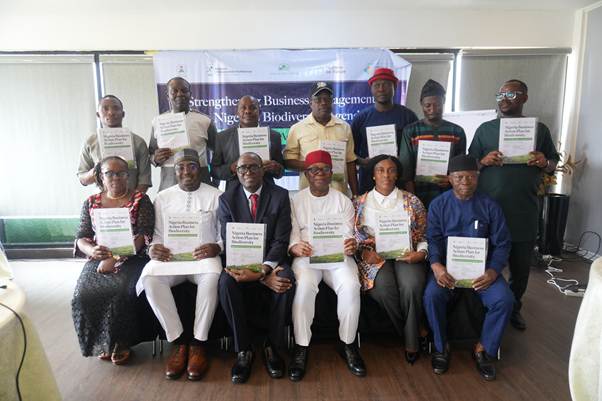
The Nigerian Conservation Foundation (NCF), in collaboration with Natural Eco Capital (NEC), the Federal Ministry of Environment and other partners, officially launched the plan on 16 September 2026 in Abuja. Held under the theme, “Mobilising Private Sector Leadership and Finance for Nature-Positive Growth in Nigeria,” the event brought together representatives from government, business, finance, academia, development organisations and the media.
The launch marks a shift from national biodiversity commitments towards practical action by businesses and financial institutions. It reinforces a fundamental principle: Nigeria’s economic prosperity depends on the health of its natural environment.
Why Biodiversity Matters to Nigerian Businesses
Healthy ecosystems provide essential services that sustain businesses and livelihoods. Agriculture depends on fertile soils, pollinators and reliable water supplies, while manufacturing, infrastructure and extractive industries rely on natural resources and functioning ecosystems.
However, habitat destruction, pollution and unsustainable resource use threaten these natural assets, exposing businesses to supply-chain disruptions, resource scarcity, operational risks and rising costs.
The National Business Action Plan for Biodiversity responds to these challenges by encouraging businesses to understand their impacts and dependencies on nature and incorporate biodiversity into everyday decision-making. Conservation is not merely an environmental responsibility; it is also an investment in long-term business resilience and economic stability.
What Is Nigeria’s Business Action Plan for Biodiversity?
The BAP translates Nigeria’s National Biodiversity Strategy and Action Plan (NBSAP) 2025–2030 and the Kunming-Montreal Global Biodiversity Framework (KM-GBF) into practical business action.
Developed through collaboration involving the Federal Ministry of Environment, NCF, Natural Eco Capital, Business for Nature, the West African Capital Coalition Hub and private-sector stakeholders under the Business Advisory Group, the plan provides a coordinated framework for government and businesses to pursue shared biodiversity objectives.
It encourages companies to integrate nature into corporate governance, investment decisions, procurement, supply chains, risk assessment, financing and environmental reporting. Importantly, the framework recognises that businesses differ in size, capacity and environmental exposure. It therefore provides proportionate implementation pathways for large corporations, financial institutions, projects and small and medium-sized enterprises (SMEs).
Moving Biodiversity into Business Strategy
A key message from the launch was the need to move beyond treating biodiversity as a corporate social responsibility activity and integrate it into core business operations.
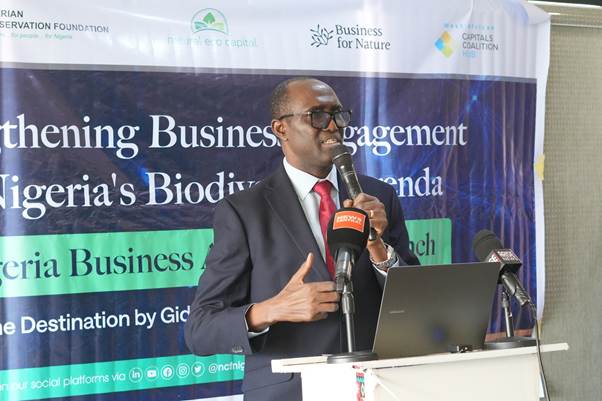
During a technical presentation on the BAP implementation manual and corporate toolkit, Dr Eugene Itua, Chief Executive Officer of Natural Eco Capital, explained how businesses can systematically assess their relationship with nature and respond to associated risks and opportunities.
The BAP outlines an eight-stage operating cycle: Govern, Scope and Screen, Locate, Evaluate, Assess, Commit and Plan, Act, Track and Disclose. This process guides businesses from establishing internal responsibility and identifying nature-related risks to implementing measures, monitoring progress and reporting results.
The framework also emphasises avoiding environmental harm wherever possible, reducing unavoidable impacts and supporting appropriate restoration. The objective is to move from broad environmental commitments to evidence-based action and measurable outcomes.
Four Global Biodiversity Targets
The BAP prioritises four targets under the Kunming-Montreal Global Biodiversity Framework:
- Target 14: Policy integration. Encourages the integration of biodiversity into planning, investment and decision-making across sectors.
- Target 15: Corporate assessment and disclosure. Promotes the assessment and disclosure of business impacts, dependencies, risks and opportunities related to nature.
- Target 18: Harmful incentives. Focuses on addressing incentives that harm biodiversity and identifying more sustainable alternatives.
- Target 19: Resource mobilisation. Promotes the mobilisation of financial resources for biodiversity conservation and restoration.
Together, these targets provide a pathway for aligning business operations and financial decisions with national and global biodiversity priorities.
Strengthening Government-Business Collaboration
In his presentation, “Building Together: Government–Business Synergy for BAP,” NCF Director-General, Dr Joseph Onoja, described the plan as a bridge between Nigeria’s biodiversity commitments and the commercial decisions that shape economic activity.
He emphasised that nature is a foundational form of capital for businesses, influencing resource availability, supply chains, operational continuity and long-term profitability.
The implementation framework assigns complementary responsibilities to government, businesses, financial institutions and other stakeholders. Government institutions will support policy coordination and enabling measures, while existing regulatory bodies retain their respective statutory mandates.
The Business Advisory Group (BAG) and its Secretariat will support implementation through coordination, practical tools, pilot initiatives, peer learning and progress reporting. The group is designed as a coordination mechanism, not a regulator or assurance provider. Effective collaboration will be essential to translating the framework into practical action across sectors.
Bringing SMEs into the Biodiversity Agenda
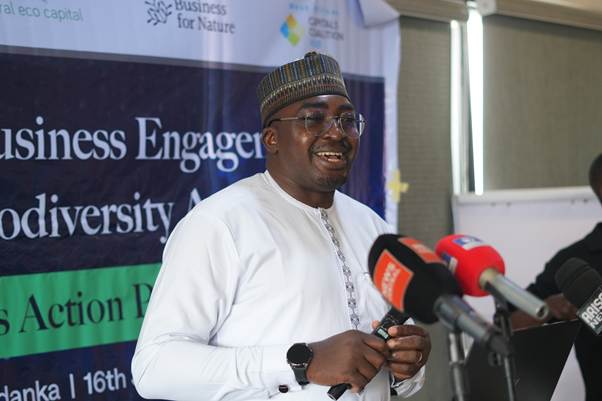
The success of the BAP will depend on participation across the business community, including Nigeria’s small and medium-sized enterprises. During the launch, the Small and Medium Enterprises Development Agency of Nigeria (SMEDAN) highlighted the relationship between environmental stewardship and sustainable economic growth. Healthy ecosystems support agriculture, water security, supply chains and community wellbeing.
SMEDAN also expressed readiness to work with partners to extend the BAP to businesses of different sizes. The plan’s proportionate implementation pathways are intended to make participation more accessible, supported by practical guidance, capacity building and sector-specific tools. This is particularly important for smaller enterprises that may have limited resources or experience in biodiversity assessment and reporting.
Nature-positive growth requires action throughout business value chains, not only among large corporations.
Mobilising Finance for Nature
Implementing biodiversity commitments requires appropriate financing. The BAP highlights opportunities to connect private capital, public resources and development finance with credible conservation and restoration initiatives.
Potential mechanisms include blended finance, green and sustainability-linked instruments, and payments for ecosystem services. These approaches must be supported by safeguards, credible evidence and transparent reporting to ensure that investments deliver genuine biodiversity benefits.
Dr Emmanuel Akinwunmi, President and Chief Executive Officer of Financing and Partnerships Africa Limited, emphasised that the value of the BAP would depend on the actions taken after its launch. His message reinforced the importance of connecting commitments with finance, partnerships, accountability and measurable delivery.
From Launch to Implementation by 2030
The unveiling of the BAP marks the beginning of its implementation phase. The roadmap provides for the development of a digital toolkit, corporate onboarding, baseline assessments, pilot initiatives and sector-specific guidance. It also envisages systems for data management, monitoring and reporting.
Key milestones include scaling implementation in 2027, aligning with the planned mandatory reporting phase for large companies in 2028, conducting an independent mid-course evaluation in 2029, and completing the implementation cycle and developing a successor strategy in 2030.
Progress will ultimately be measured not simply by the number of businesses making commitments or activities undertaken, but by whether implementation reduces pressures on nature, improves ecosystem condition and promotes fair participation in its benefits.
A Shared Responsibility for Nigeria’s Natural Heritage
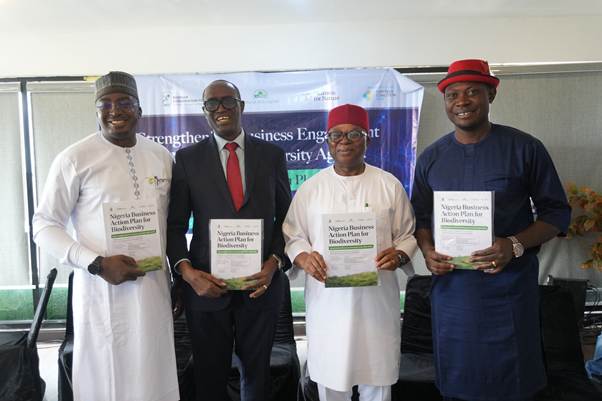
The launch of Nigeria’s National Business Action Plan for Biodiversity establishes a framework for businesses to become active partners in protecting the country’s natural heritage while supporting sustainable economic growth.
The next phase will require practical tools, sustained stakeholder engagement, accessible support for SMEs, effective institutional coordination and credible biodiversity finance. Government, businesses, financial institutions, conservation organisations and communities all have roles to play.
Nigeria’s natural ecosystems are essential to its economic resilience and the wellbeing of present and future generations. The challenge now is to translate the BAP from a national framework into decisions, investments and actions that deliver lasting benefits for nature, people and the economy.