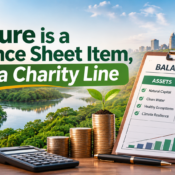
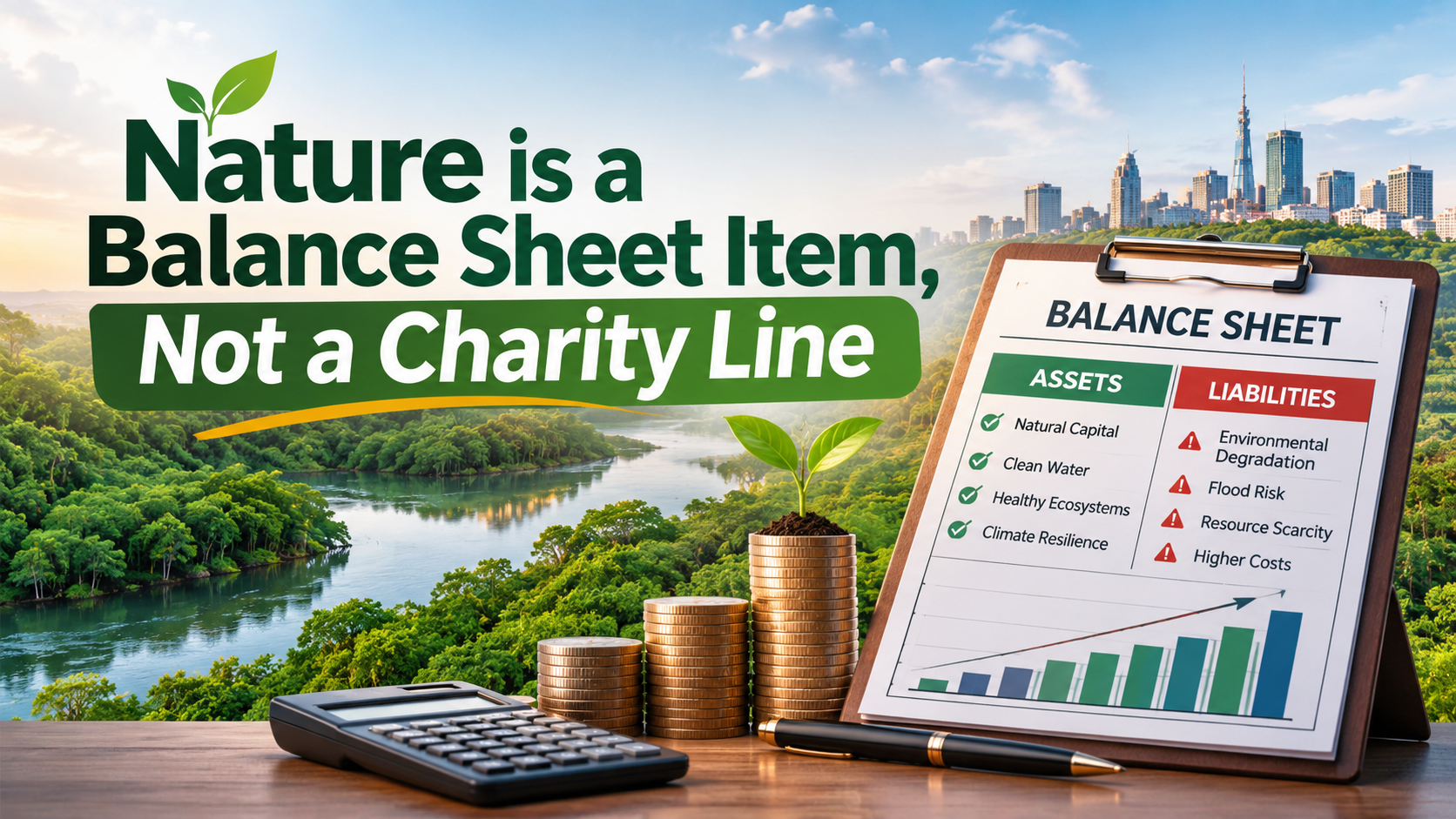
Nature Is a Balance Sheet Item, Not a Charity Line
By Adeoye-Wilson Kupolati
Head, Strategy & Innovation, Nigerian Conservation Foundation
Edited By
Olusomi Oduguwa
Head, Communications & Corporate Branding, Nigerian Conservation Foundation
Between 2019 and 2025, the Nigerian Conservation Foundation (NCF), through its Green Recovery Nigeria programme, recorded more than 2.8 million trees planted across the country, working with corporate organisations, development partners and other stakeholders.
That framing hides what these companies already know in practice. Healthy ecosystems protect their sites from floods, keep water clean and supply the raw materials they use. Nature is an input to the business, and losing it is a financial risk. Thus, it belongs on the balance sheet conversation, not only in the CSR budget.
Nature is often treated as a charitable cause, something businesses support through annual donations, tree-planting exercises or environmental campaigns. That approach overlooks a fundamental reality: businesses depend on nature in ways that are both direct and measurable. A mangrove belt slows storm surge. A wooded catchment filters water before it reaches a borehole. Roots hold soil on a slope above a road. None of this appears in a trial balance, which is why it is easy to ignore.
These natural assets constitute what is known as natural capital. Like physical and financial capital, natural capital has economic value. When it is degraded, the consequences can appear in a company’s operating costs, supply chains, asset values and exposure to risk.
The Economic Cost of Ignoring Nature
Nigeria’s 2022 floods offer a stark illustration of what happens when environmental pressures meet vulnerable infrastructure and settlements. A World Bank Global Rapid Post-Disaster Damage Estimation (GRADE) assessment placed the median estimate of direct economic damages at US$6.68 billion, with a range of US$3.79 billion to US$9.12 billion.
While extreme rainfall and climate change contributed to the disaster, the loss of wetlands, vegetation clearance, development on floodplains and inadequate drainage can intensify its effects. These factors increase the exposure of businesses, communities and infrastructure to flooding.
For businesses, the implications extend beyond physical damage. Flooding can interrupt production, restrict access to facilities, damage agricultural land and disrupt the transport networks that connect suppliers to markets. Manufacturers may also face difficulties accessing reliable water supplies and raw materials.
The broader lesson is that environmental degradation weakens the natural and physical systems on which economic activity depends. Businesses that overlook these connections risk underestimating their exposure to environmental change.
Four Ways Businesses Depend on Nature
These economic consequences become easier to understand when we examine the natural systems that businesses depend on, often without recognising their value.
1. Flood and Storm Protection
Mangroves, wetlands and coastal vegetation help absorb wave energy, reduce erosion and protect settlements and infrastructure from storm impacts. Where these ecosystems are cleared or degraded, coastal businesses and communities may face greater exposure to flooding and physical damage.
2. Water Supply and Quality
Forests and healthy catchments help regulate water flows, reduce sedimentation and support water quality. Industries that depend on reliable water supplies, including manufacturing, agriculture, food processing and hospitality, pay for treatment, trucking or a new borehole.
3. Raw Materials and Productive Resources
Many businesses depend directly on nature for timber, fish, agricultural produce, fibres and other biological resources. The degradation of forests, rivers, soils and marine ecosystems can reduce the availability and quality of these inputs, affecting production costs and supply reliability long before they show up in an annual report.
4. Land and Coastal Stability
Vegetation and healthy soils help hold land together, regulate erosion and maintain productive landscapes. Their loss can accelerate gully erosion, degrade agricultural land and threaten roads, facilities and other infrastructure. These dependencies are not abstract environmental concerns. They influence where businesses operate, how reliably they produce goods and services, and how much it costs to maintain their assets.
From Environmental Damage to Financial Liability
The financial consequences of nature-related risks rarely stop at the boundaries of an affected business. A washed-out road can halt deliveries for every company along a route. A polluted river can increase water treatment costs for users downstream. Repeated flooding can make a business location harder to insure and reduce the value of its assets as collateral.
These risks can also spread through supply chains, affecting businesses that may have little direct exposure to the original environmental damage. For lenders and insurers, this makes the condition of ecosystems and the resilience of business locations increasingly relevant to decisions about financing, insurance and investment.
There is another side to this relationship. Businesses do not only depend on nature; they also affect it. Land clearing, pollution, untreated effluent discharge, oil spills and unsustainable resource extraction can degrade ecosystems and undermine the natural services on which communities and other businesses depend.
Where these impacts cause harm, companies may face remediation costs, regulatory action, legal claims and reputational damage. They may also encounter greater scrutiny from investors, lenders, customers and regulators as expectations around environmental responsibility and disclosure continue to evolve.
Nature-related financial risk, therefore, is not limited to what happens when ecosystems fail. It also includes the financial consequences of how businesses interact with and affect the natural environment.
Sustainability Reporting Is Changing the Business Conversation
The expectations placed on businesses are evolving. Investors, regulators and other stakeholders increasingly want to understand how sustainability-related issues affect an organisation’s performance, prospects and resilience.
Nigeria’s adoption of the International Financial Reporting Standards (IFRS) Sustainability Disclosure Standards, IFRS S1 and IFRS S2, is part of this shift. Under the phased implementation framework announced by the Financial Reporting Council of Nigeria, mandatory application for public interest entities is scheduled to begin for reporting periods starting on or after 1 January 2028, with a later timeline for small and medium-sized enterprises.
IFRS S1 requires organisations to disclose material sustainability-related risks and opportunities that could affect their prospects, including their cash flows, access to finance or cost of capital. These may include risks arising from a company’s dependence on nature and the impact of its activities on natural systems.
The International Sustainability Standards Board (ISSB) is also taking further steps. On 22 October 2026, it published an exposure draft of a proposed Practice Statement on nature-related disclosures. The proposal draws on the Taskforce on Nature-related Financial Disclosures (TNFD) framework and is intended to help organisations apply existing IFRS S1 requirements to nature-related matters. It is a proposed guidance document, not a new mandatory disclosure standard.
For Nigerian businesses, the direction is significant. Nature-related risks are increasingly relevant to financial decision-making, corporate reporting and investment assessments. Companies that begin understanding these risks now will be better prepared for changing expectations.
Nature Conservation as a Strategic Investment, Not a Donation
Once dependencies are named, spending on nature can be judged like any other capital decision. Restoring a wetland upstream of a plant, replanting a degraded catchment or protecting a mangrove belt in front of a coastal facility is often cheaper than the drains, sea walls and treatment plants needed to replace them, and it keeps working without fuel or spare parts.
Seen this way, the trees planted under Green Recovery Nigeria and similar programmes are not only goodwill. Placed in the right catchments, near the right assets, they reduce flood exposure, protect water supply and hold soil in place. The difference between a CSR project and a risk investment is not the activity. It is whether the company chose the site because of what it protects, and whether it measures the result.
There is a financing angle too. Banks under the Central Bank of Nigeria’s Sustainable Banking Principles are expected to weigh environmental risk in lending, and international investors increasingly ask about nature alongside climate. A company that can show it understands and manages its nature dependencies is a better credit and a more credible partner.
For businesses, meaningful investment in nature begins with understanding which ecosystems their operations depend on, what pressures threaten those ecosystems and how restoration or protection can reduce exposure while delivering wider benefits. – Adeoye-Wilson Kupolati
Where Should Businesses Start? A Practical Nature Dependency Screen
A company does not need to begin with an expensive, organisation-wide assessment. A practical first step is to identify where its operations and supply chains intersect with nature.
Businesses can start by asking five questions:
- Where do we operate? Map major facilities, production sites, farms, infrastructure and key suppliers.
- Which ecosystems are present? Identify nearby forests, wetlands, rivers, coastlines, grasslands and other natural assets.
- What services do we depend on? Consider water supply, flood protection, soil stability, raw materials and other ecosystem services essential to operations.
- What pressures threaten these services? Examine flooding, erosion, pollution, habitat loss, water scarcity and climate-related pressures.
- What are the business consequences? Rank the potential implications for operating costs, assets, production, supply chains, reputation and regulatory exposure.
The TNFD’s LEAP approach offers a useful framework for taking this assessment further. LEAP stands for Locate, Evaluate, Assess and Prepare. It guides organisations to locate their interfaces with nature, evaluate their dependencies and impacts, assess related risks and opportunities, and prepare to respond and report.
The objective is not simply to produce another sustainability document. It is to make nature-related information useful to business decisions.
Making Nature Risk Part of Business Strategy
Three actions can help move businesses from awareness to implementation:
- Define a Clear Ownership Structure: Put nature risk under a named executive and a board committee, alongside climate/sustainability teams. Sustainability teams should not carry the responsibility alone. Finance, operations, procurement, risk management and senior leadership all have a role to play.
- Quantify the Most Significant Exposures: Businesses should identify the ecosystems and natural services most critical to their operations, assess the consequences of their degradation and determine where investment in protection or restoration can reduce risk.
- Engage Beyond the Company Fence: Nature-related risks often extend across supply chains, landscapes and communities. Working with government, conservation organisations, forums like the Business Advisory Group, local communities and other businesses can help address shared environmental pressures more effectively.
The Business Case for Protecting Nature
The economic case for nature conservation is becoming harder to ignore. Healthy ecosystems support water security, productive land, resilient infrastructure, reliable supply chains and safer communities. Their degradation can weaken all of these foundations.
For Nigerian businesses, the question is no longer whether nature has economic value. It is whether that value is being recognised in corporate planning, investment decisions and risk management. The way to go is to treat that value the way they treat any other asset: count it, protect it and report on it.
Companies that understand their dependencies and impacts can make better-informed decisions, anticipate emerging risks and identify opportunities to contribute to a more resilient economy.
Nature will not send an invoice in advance. It will simply stop providing the service, and the cost will land in the accounts all the same. – Adeoye-Wilson Kupolati.