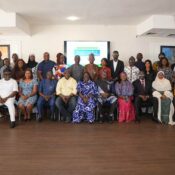
At a time when the world is grappling with climate instability, biodiversity loss, and deepening social inequality, the question of how humanity relates with nature has never been more urgent. Are we owners of the Earth, free to exploit it at will or stewards, entrusted with its care for generations yet unborn?
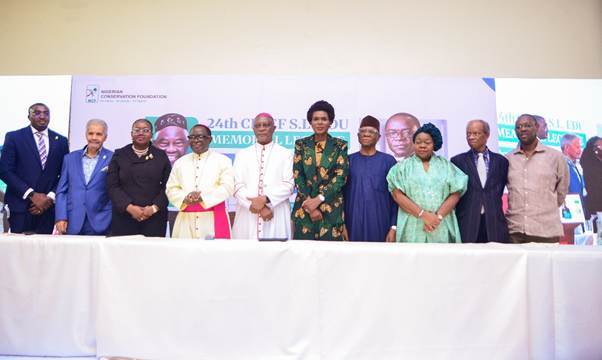
This moral tension formed the heart of the 24th Chief S.L. Edu Memorial Lecture, convened by the Nigerian Conservation Foundation (NCF) on Friday, 30 January 2026, under the theme “To Have and To Hold: Faith and Care of the Environment.” More than a ceremonial gathering, the lecture was a moment of reflection, conscience, and recommitment bringing faith, science, policy, and advocacy into a shared conversation about the future of our common home.
The Chief S.L. Edu Memorial Lecture: A Platform for Ideas That Shape Action
Instituted in honour of Chief S.L. Edu, one of Nigeria’s foremost environmental pioneers and the founding father of the Nigerian Conservation Foundation, the annual memorial lecture has, for over two decades, served as a leading advocacy platform for environmental thought leadership in Nigeria and beyond.
Each edition convenes eminent voices to interrogate critical conservation issues, situating global environmental challenges within the Nigerian context while inspiring policy action, public awareness, and intergenerational responsibility. The 24th edition continued this legacy, deliberately foregrounding the moral and spiritual dimensions of environmental care.

History of the Founder: Chief S.L. Edu
Chief S.L. Edu was born on 7th January 1911 in Epe, Lagos State. His life story is that of a royal prince who rose from humble beginnings to greatness through hard work, discipline, ambition, intelligence, and deep faith in God. He received sound Islamic and Western education at Government Primary School, Epe, Qur’anic School, and later the Epe Government School. He entered the private sector early, beginning with Holland West Africa Line in 1930. By 1945, he had established his own business interests, spanning shipping, stevedoring, transport, contracting, aviation representation (including being the sole agent of Fokker aircraft in Nigeria), and insurance, founding African Alliance Insurance Company in 1960.
Chief Edu’s business empire was vast and diverse. He was widely recognized as a business mogul, both locally and internationally. In commerce, he was a towering figure. Between the 1950s and 1970s, he dominated the Chambers of Commerce sector. He served as President of the National Association of Chambers of Commerce, Industry, Mines & Agriculture (1963–1968) and President of the Federation of Commonwealth Chambers of Commerce (1960–1968). He was Life Patron of the Nigeria-British Chamber (1977) and facilitated the Nigeria–Netherlands Chamber. He chaired several companies including Blackwood Hodge, Glaxo, and HP Nigeria. Yet his impact extended to public service. He served twice as Commissioner for Health and Social Services in the Western Region (1962) and Lagos State (1967).
Chief Edu was a notable philanthropist, supporting institutions such as the University of Lagos, Lagos State University, Obafemi Awolowo University, and Ogun State University. Religious organizations also benefited from his generosity, including Anwar-Ul-Islam Movement, St. John’s African Church, the Cathedral Church of Christ, and the YMCA — reflecting his respect for diverse faiths.
He received many honours, including MFR (1965), Officer of the Order of Orange-Nassau (Netherlands, 1974), and CON (2000), as well as an honorary D.Litt. from Lagos State University. He was Mogaji-Ngeri of Epe and achieved several “firsts,” including first Nigerian President of the Rotary Club of Lagos.
Despite his accomplishments, he remained deeply connected to conservation. With like-minded environmentalists, he founded the Nigerian Conservation Foundation in 1980, registered in 1982. He is rightly regarded as the Father of Conservation in Nigeria. His faith was central to his conservation philosophy. As noted by HRH Prince Bernhard of the Netherlands, Chief Edu believed deeply that “the natural environment is governed by the laws of God.” Chief Edu passed peacefully on 8th January 2002 and was laid to rest in Epe.
Chief Edu believed that environmental protection was inseparable from national development, human dignity, and ethical leadership. At a time when conservation was scarcely understood or prioritised, he championed the protection of Nigeria’s natural heritage, insisting that development devoid of environmental responsibility was ultimately self-destructive. His philosophy was rooted in foresight, discipline, and moral responsibility values that continue to define NCF’s work more than four decades later.
The memorial lecture stands not only as a tribute to his life, but as a living extension of his conviction that ideas, when anchored in values, can transform societies.
A Convergence of Moral, Institutional, and Policy Voices
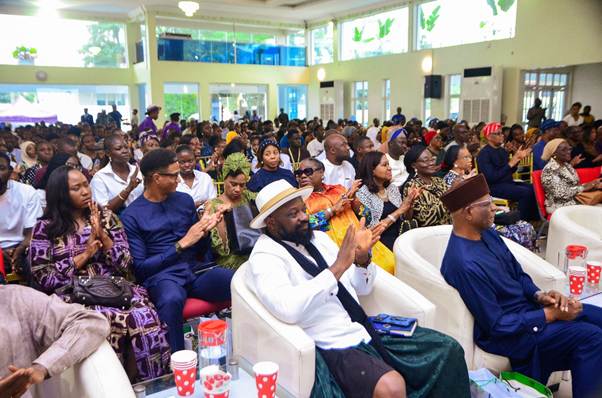
The lecture drew an impressive array of dignitaries and stakeholders, reflecting the breadth of influence required to address today’s environmental crises. In attendance were:
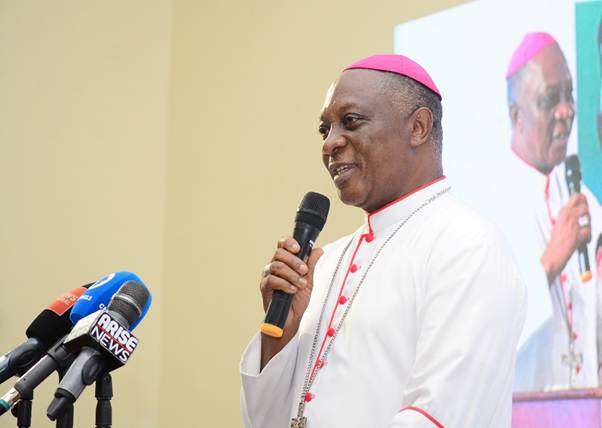
- Special Guest of Honour: Most Rev. Dr. Alfred Adewale Martins, Archbishop of the Metropolitan See of the Catholic Archdiocese of Lagos
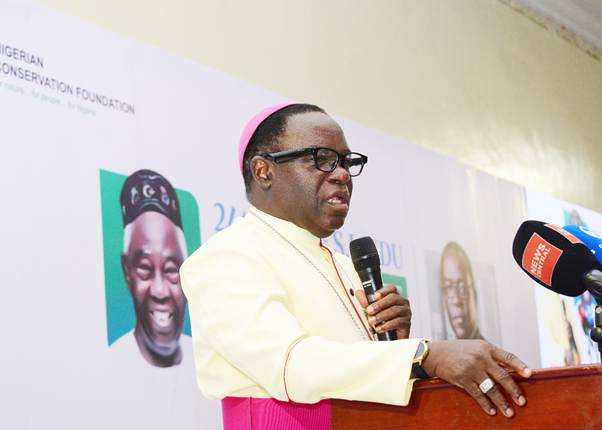
- Guest Speaker: Most Rev. Dr. Matthew Hassan Kukah, Bishop of the Catholic Diocese of Sokoto
- Representative of Chevron Nigeria Limited, Mrs. Ebisan Akinsanya
- Members of the NCF National Executive Council
- Representatives of the Cross River State Government, including the Accountant General, Mrs. Glory Effiong, and the Senior Special Adviser on Biodiversity and Conservation, Hon. Cletus Ugbizi
- Faith groups, academics, students, conservation professionals, and civil society actors
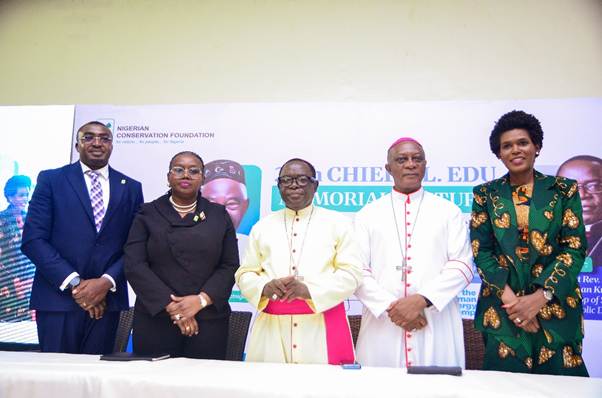
The diversity of voices underscored a central truth: environmental stewardship is not the responsibility of one sector alone but a shared moral and civic duty.
Faith as Moral Authority: Archbishop Martins’ Goodwill Message
In his goodwill message, Archbishop Alfred Adewale Martins offered a profound reflection on the Catholic Church’s commitment to environmental stewardship, drawing inspiration from Laudato Si’, Pope Francis’ landmark encyclical on care for our common home.
He reminded the audience that concern for the environment is not optional, but a moral, spiritual, and social imperative inseparable from social justice and the dignity of the human person. From youth-led initiatives like the Network of Young Catholic Carers for the Environment (NYCCEN) to advocacy for responsible consumption, renewable energy, and waste reduction, the Archbishop highlighted practical actions taken by the Archdiocese to translate faith into environmental responsibility.
His message affirmed the vital role faith communities play in shaping values, behaviours, and public conscience especially at a time when ecological degradation increasingly threatens human survival.
To Have and To Hold: Bishop Kukah’s Moral Challenge
Delivering the keynote lecture, Most Rev. Dr. Matthew Hassan Kukah, Bishop of the Catholic Diocese of Sokoto, offered a compelling moral interrogation of humanity’s relationship with creation.
Anchored in the lecture theme, Bishop Kukah challenged the notion of ownership divorced from responsibility. He argued that faith demands stewardship, not domination calling attention to how unchecked consumption, exploitation of natural resources, and indifference to environmental damage reflect deeper ethical failures.
He urged society to see environmental degradation not merely as a technical or policy problem, but as a moral crisis one that disproportionately harms the poor and future generations. Faith, he noted, must compel restraint, accountability, and reverence for life in all its forms.
His address resonated deeply, reframing environmental care as a covenant to have and to hold the Earth with trust, humility, and responsibility.
Investing in Knowledge: PhD Research Grants for Conservation
A defining feature of the Chief S.L. Edu Memorial Lecture is its commitment to advancing scientific knowledge. With the support of Chevron Nigeria Limited, the 2026 edition awarded PhD Research Grants to two outstanding scholars whose work addresses critical environmental challenges:
- Arikpo Okoi Eteng (Ahmadu Bello University, Zaria)
Monitoring and Assessment of Sea Turtle Bycatch in Artisanal and Commercial Fishing in the Gulf of Guinea, focusing on key nesting sites across Nigeria’s coastline. - Ezekiel Temitayo Adedeji (Federal University of Technology, Akure)
Models for Estimating Diameter Class-Wise Volume and Biomass of Timber Species in Tropical Rainforest Ecosystems, contributing to sustainable forest management and climate mitigation.
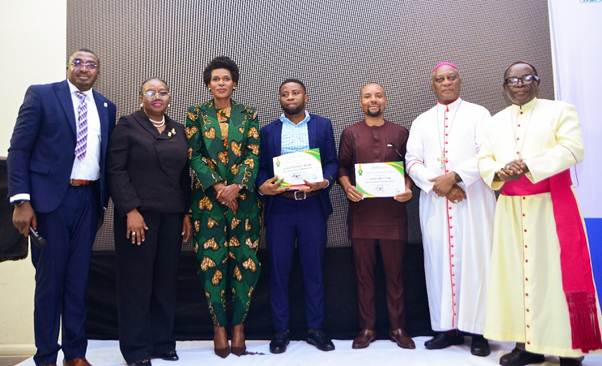
These grants reinforce NCF’s belief that evidence-based research is essential to informed policy, effective conservation, and long-term sustainability.
Why This Lecture Matters Now
In an era marked by climate emergencies, biodiversity collapse, and widening inequality, the 24th Chief S.L. Edu Memorial Lecture offered something increasingly rare: a values-driven framework for environmental action.
By bringing faith into dialogue with science and policy, the lecture reminded participants that environmental sustainability is not only about laws, technologies, or funding but about conscience, ethics, and collective responsibility.

Holding the Earth Differently
The call emerging from the lecture was clear: humanity must relearn how to hold the Earth not as a possession to be exhausted, but as a trust to be protected. This requires courage, collaboration, and moral clarity across generations and institutions.
As Chief S.L. Edu envisioned, conservation is ultimately about safeguarding life human and non-human alike.
Watch the Full Lecture
Missed the event or want to revisit the conversations? 📺 Watch the full recording of the 24th Chief S.L. Edu Memorial Lecture on YouTube: https://www.youtube.com/live/dZFmvqc9qMA
About the Nigerian Conservation Foundation (NCF)
The Nigerian Conservation Foundation is Nigeria’s foremost environmental NGO, established in 1980 by Chief S.L. Edu. NCF is dedicated to preserving the nation’s natural heritage through advocacy, research, education, and strategic partnerships. Working with local communities, government, and international organisations, NCF continues to champion biodiversity conservation and sustainable development in Nigeria.