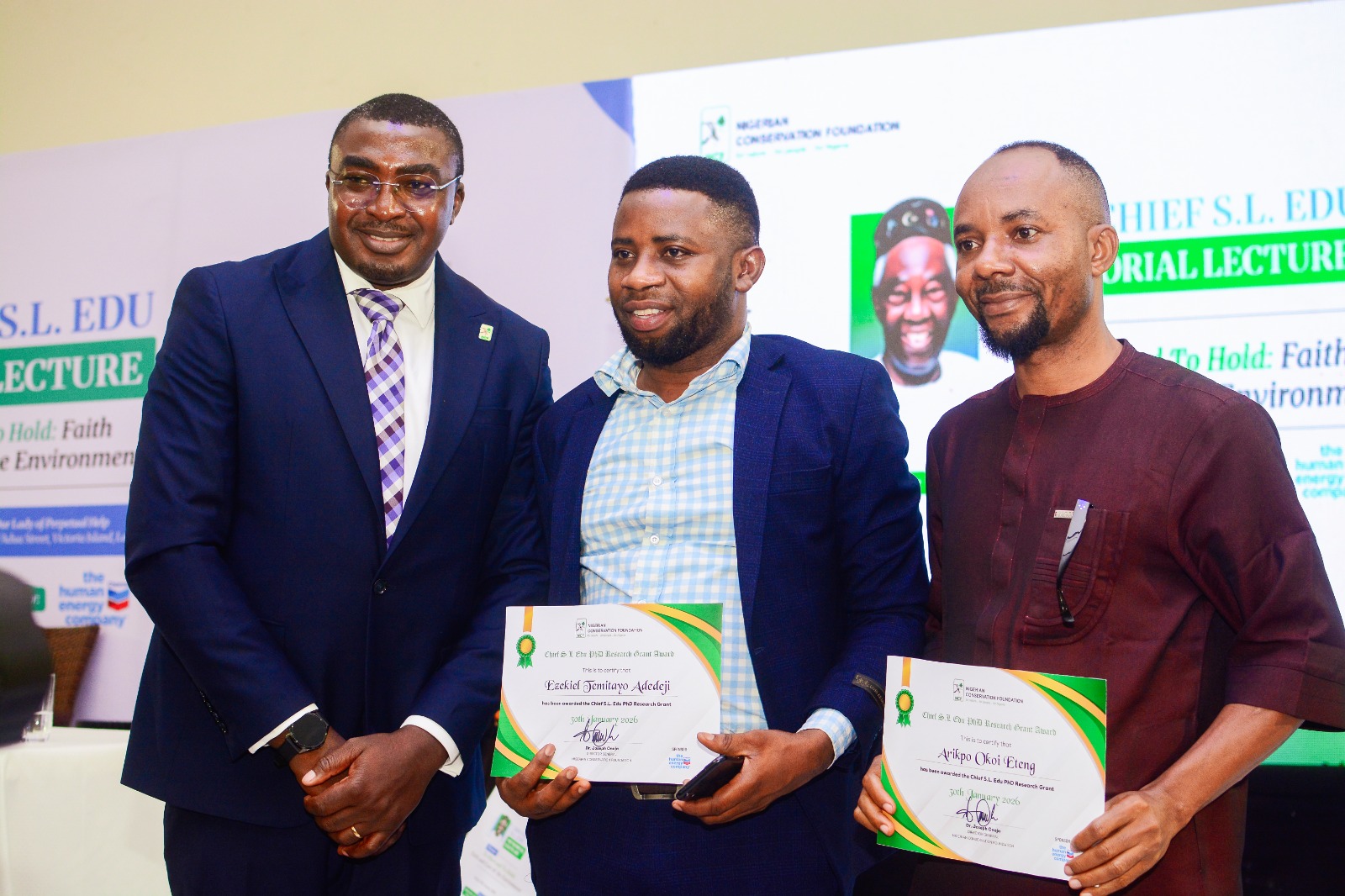
The Nigerian Conservation Foundation (NCF) invites applications from qualified Nigerians for the 2027 Edition of the Chief S.L. Edu Memorial Ph.D. Research Grant, sponsored by Chevron Nigeria Limited (CNL). The grant supports research in natural sciences, social sciences, environmental law, and related fields to promote sustainable natural resource management in Nigeria.
The award aims to recognise and reward scholarly contributions that enhance habitat restoration, resource management, climate resilience, and biodiversity conservation for the benefit of nature and humanity.
This year’s theme is: “Conserving Species, Restoring Landscapes and Supporting Livelihoods”.
NCF is a foremost, membership-based environmental Non-Governmental Organisation (NGO) dedicated to the promotion of nature conservation, natural and environmental resource management and sustainable development issues in Nigeria. NCF was established by late Chief S.L. Edu in 1980 and became a registered charitable trust in 1982 under the Land (Perpetual Succession) Act of 1961, which was later superseded by the Companies and Allied Matters Act of 1990. NCF is the BirdLife Partner in Nigeria, an Associate of the Worldwide Fund for Nature (WWF) and a Member of the World Conservation Union – the International Union for Conservation of Nature (IUCN). Also, NCF is a Partner of the Royal Society for the Protection of Birds (RSPB), Wetlands International, and Fauna & Flora International (FFI).
NCF has a vision of being “A leader in creating sustainable societies where people and nature thrive” while, through its mission, it protects and restores natural resources, tackles emerging environmental threats in partnership with communities and other stakeholders, for the benefit of present and future generations by:
- Conserving the full range of Nigeria’s biodiversity, which includes species, ecosystems and genetic biodiversity;
- Promoting the sustainable use of natural resources for the benefit of present and future generations; and
- Undertaking field interventions and advocacy programmes to promote best practices in climate change adaptation and mitigation; minimise pollution as well as reduce wasteful utilisation of renewable resources.
Please Note:
Candidates will be selected based on (among others) the quality of their research proposals and the following requirements:
- Candidates must be Nigerian citizens.
- Candidates must have an MSc degree or its equivalent in Natural Sciences, Social Sciences or Law (Environmental Law/Protection), but related to natural and environmental resource management.
- Candidates must have secured admission into a Nigerian university towards a Ph.D. degree in any of the fields stated in (ii) above.
- Candidates’ research proposals must be in line with the theme and must be tailored to the achievement of NCF’s vision and mission statements.
- Candidates must be members of the Nigerian Conservation Foundation. To become a member, click here.
- A progress report (on letterheads) from the applicant’s Project Supervisor(s) stating how far he/she has gone in his/her research work and his/her role in the initial review, as well as the relevance to the objectives of the grant, is a very essential condition for considering any application. Please note that a reference letter is not equivalent to a progress report from the Project Supervisor(s).
- 200-word justification in line with the theme and with relevance to biodiversity conservation, natural and environmental resource management issues.
- A 3,000-word project proposal to be submitted should contain the Title, Introduction/Statement of Problem, Objectives, Methodology and Expected Outputs, etc.
- Curriculum vitae (not more than 2 pages detailing research and work experience).
- Scanned copy of admission letter.
- Applications are encouraged to be in file format or folders for uniformity and easy retrieval.
Method of Application:
Applicants should complete the grant application form online here: https://ncfnigeria.org/2027-chief-edu-grant/
To become a member of NCF, visit: https://ncfnigeria.org/individual/
Deadline for Application:
11 December 2026.
No paper application(s) will be considered. Applicants should not submit more than one proposal for consideration.
Please note that all applications received will be acknowledged, while only the successful candidates/applicants will be contacted by the Foundation.